







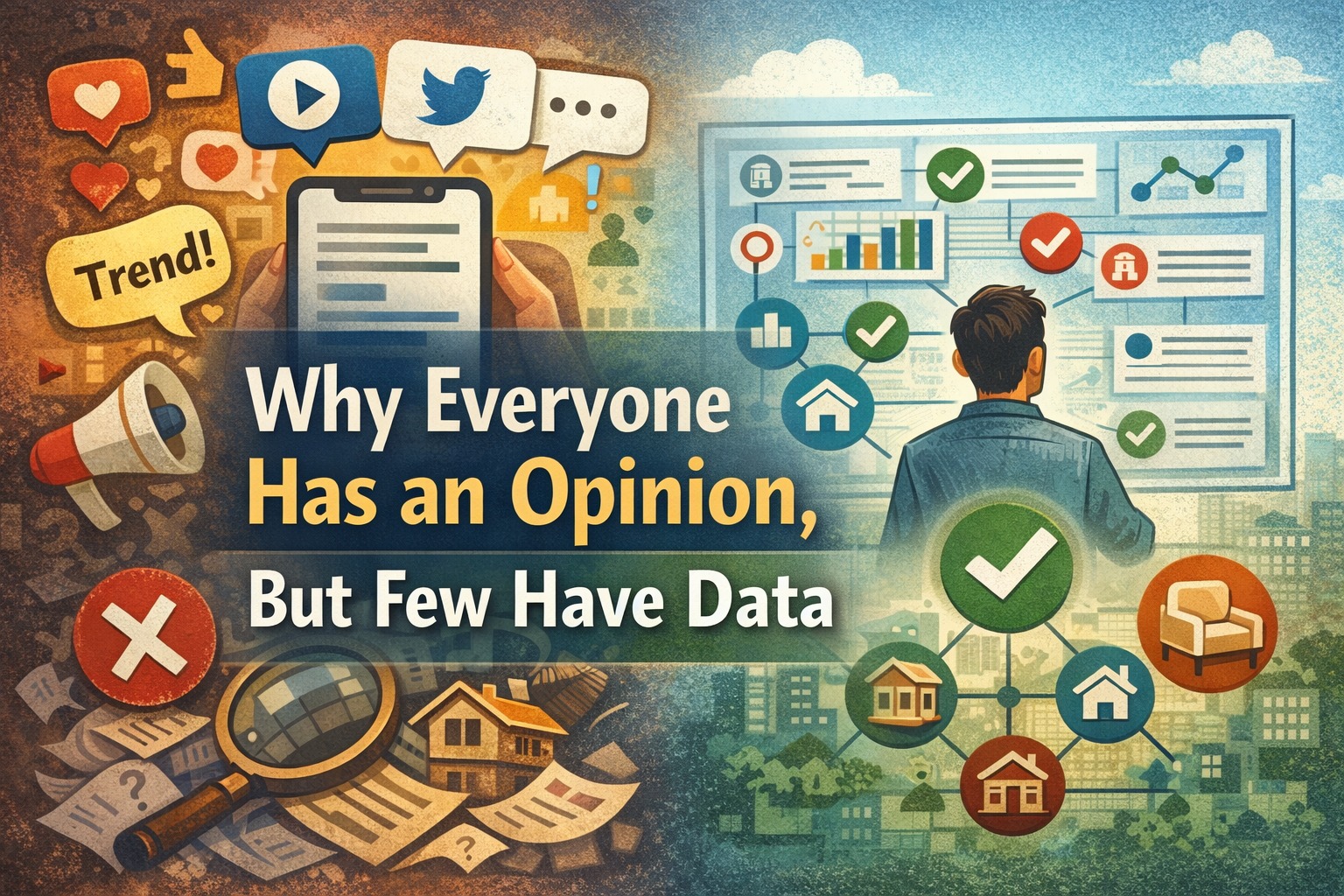
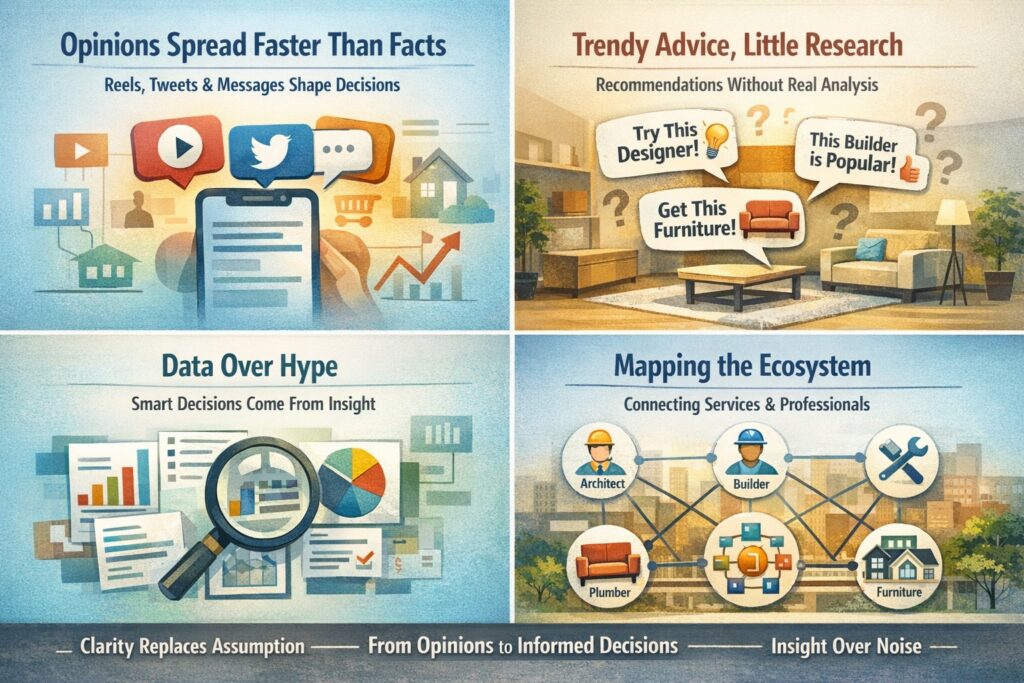
In today’s digital-first world, opinions move faster than facts.
A single reel, tweet, or forwarded message can shape buying decisions, influence investments, and even decide how people design their homes.
The real problem isn’t the lack of information.
It’s the overload of unfiltered information.
The Noise Around Every Property Decision
When someone plans a space—whether it’s a home, office, or commercial property—advice comes from everywhere.
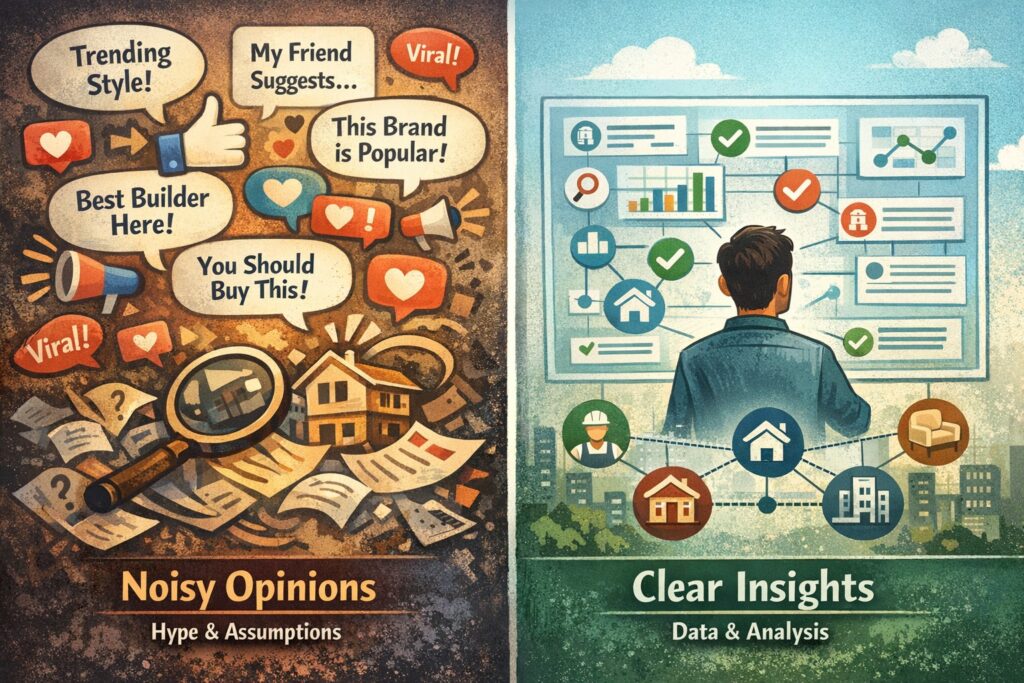
- A friend recommends a designer
- A social media post praises a builder
- A relative insists on a furniture brand
- A trending reel showcases a “must-have” interior style
None of these inputs are necessarily wrong.
But very few are backed by data, research, or ecosystem understanding.
Most decisions are made based on what looks popular, not on what is actually suitable.
Popularity vs. Suitability: The Real Risk
None of these inputs are necessarily wrong.
But very few are backed by data, research, or ecosystem understanding.
Most decisions are made based on what looks popular, not on what is actually suitable.
Popularity vs. Suitability: The Real Risk
A design trend that looks stunning online may not work in real life.
- It may not suit the local climate
- It may fail in daily functionality
- It may demand high maintenance over time
- It may not align with the property’s structure or usage
Similarly, choosing a builder or contractor simply because “everyone is choosing them” does not guarantee quality, transparency, or long-term reliability.
This is where many property decisions quietly go wrong.
Strong Decisions Are Quiet Decisions
The best decisions are rarely loud or impulsive.
They are layered, researched, and intentional.
Strong choices come from:
- Comparing verified data
- Understanding cost-to-value ratios
- Evaluating long-term impact
- Seeing how professionals and services connect as a system
A home or project is never built by isolated vendors.
It is an ecosystem—architects, builders, designers, carpenters, plumbers, furniture brands, and suppliers all influencing the final outcome. Ignoring this interconnectedness leads to gaps, delays, and compromises.
Strong choices come from:
- Comparing verified data
- Understanding cost-to-value ratios
- Evaluating long-term impact
- Seeing how professionals and services connect as a system
A home or project is never built by isolated vendors.
It is an ecosystem—architects, builders, designers, carpenters, plumbers, furniture brands, and suppliers all influencing the final outcome. Ignoring this interconnectedness leads to gaps, delays, and compromises.
Why Ecosystem Insight Matters
Modern decision-making is shifting.
The future is not about seeing more options.
It is about seeing how options relate to each other.
Insight-driven platforms are now mapping:
- Relationships between professionals
- Compatibility between services
- Practical outcomes beyond marketing claims
When this ecosystem becomes visible, clarity replaces guesswork.
You don’t just choose faster.
You choose smarter.
Where SFS Fits In
At Square Foot Story (SFS), the focus is not on opinions—it’s on perspective backed by insight.
SFS exists to:
- Decode the real estate and home ecosystem
- Replace assumptions with informed clarity
- Help people make decisions based on relevance, not noise
Because in real estate, interiors, and investments—
one wrong decision echoes for years.
The Future of Smart Decision-Making
The future isn’t about having more voices around you.
It’s about having verified insight guiding those voices.
When insight replaces assumption, confidence follows.
And clarity becomes a natural outcome—not a lucky accident.
Clarity begins where data, ecosystem understanding, and intention meet.