



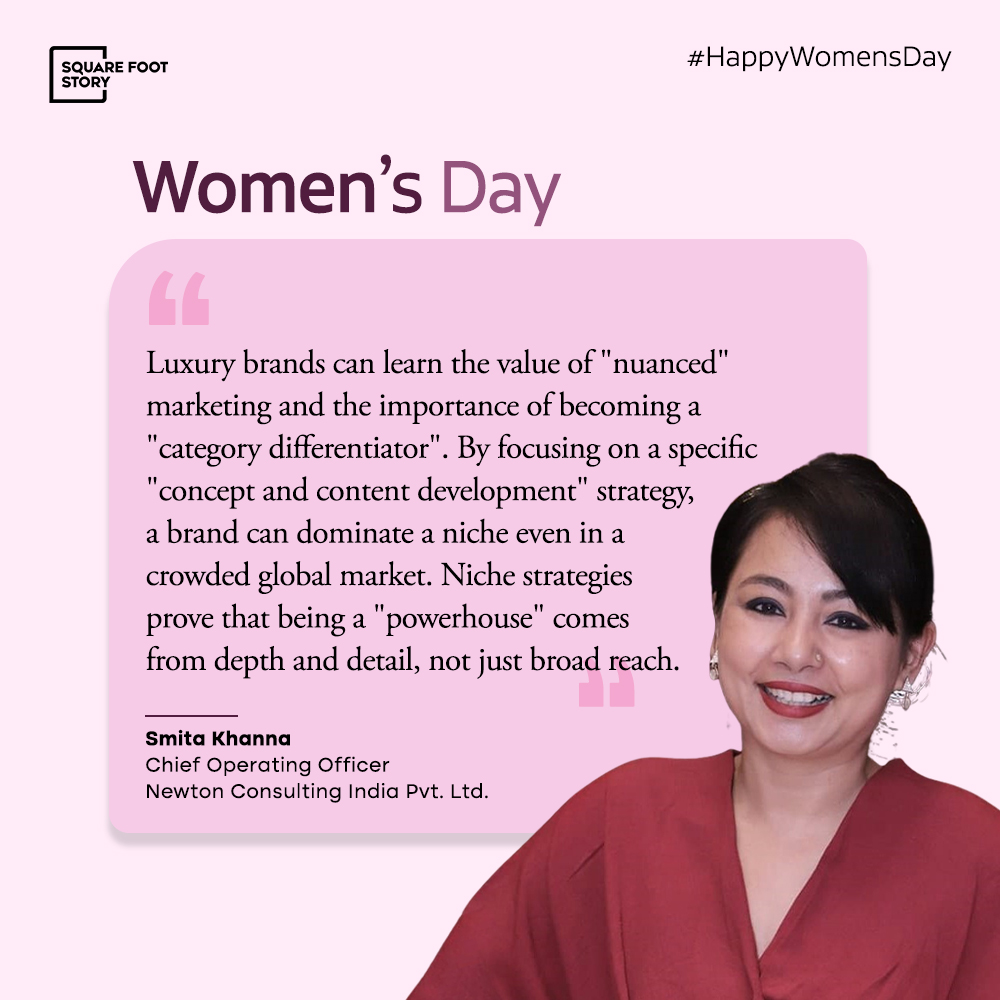
Smita Khanna, an innovator, a strategist and a good cook personally, holds vast professional experience in the media and marcom realm. Having worked with Times of India group and the India Today group, Smita learned the nuances of media marketing and specialises in brand strategy, corporate image positioning, PR-strategy and execution, concept and content development, and celebrity management.

Spanning over 19 years of experience, her career boasts endless vigour and commitment. She brings in a holistic perspective to brand communication. Her knack for looking into the obvious and the unobvious, coupled with a thorough understanding of marketing and branding concept development, has enabled many clients attain the desired brand goals and business results.
On this Women’s Day, Squarefoot Story took a deep dive into the journey of Smita Khanna, Chief Operating Officer, Newton Consulting India Pvt. Ltd., to find out how luxury brands project themselves and if influencers are the right marketing channel for luxury brands. Excerpts from the interview:
How do you define a luxury brand in today’s market?
Luxury today is the ‘Economics of Significance over Scale.’ It isn’t defined by mass appeal, but by a brand’s ability to navigate the trenches of the Science of Thought, Behaviour Patterns, and Influences at work. At Newton Consulting, we don’t just look at what people buy; we analyse the psychological patterning of “why do they desire”.
With India’s luxury market projected to reach $12.1 Billion by 2025 and nearly $19 Billion by 2034, luxury is now a predictive outcome; hence, a brand must anticipate a consumer’s need for status and self-affirmation before the consumer even articulates it.”
What are the three most important pillars of luxury brand communication?
- Trust Architecture: In an era where 63% of consumers feel the burden of data protection, luxury brands must lead with a privacy-first, ethical data strategy.
- Predictive Personalisation: Moving from ‘Hi [Name]’ to ‘I know what you need next.’ Using behavioural data to predict outcomes ensures the brand remains a constant, proactive partner in the consumer’s life.
- The Aspiration Gap: Using high-impact storytelling to ensure the brand remains universally admired but intimately understood.
Do you believe storytelling is more important than product quality in luxury branding?
While product quality is the foundation, storytelling is the engine that drives brand strategy and corporate image positioning. A brand must be a “powerhouse to reckon with” through its narrative, which allows it to reach topline goals and differentiate itself in a crowded market. Success comes from combining a result-oriented zeal with a narrative that addresses both brand goals and business results.
Do you believe influencers are the right marketing channel for luxury brands?
Only if the influence is quantifiable through behaviour. Followers are a vanity metric, and we look for ‘Engagement Velocity.’ Data shows that Nano and Micro-influencers (1k-50k followers) often drive a 10.3% engagement rate, far outperforming mega-celebrities. For luxury, the ROI isn’t just with reach but in the Prediction-Based Outcomes. If an influencer’s audience patterns align with the brand’s ‘Science of Thought’ profile, the conversion quality is significantly higher.”
Is follower count more important than credibility for luxury positioning?
Credibility is far more vital than raw numbers, as luxury positioning relies on a thorough understanding of branding concepts and market nuances. High-quality engagement and “unmitigated zeal for results” are the true markers of a successful partnership. Relying on credibility ensures the brand maintains its status as an innovative “planner and doer” rather than just a trend-follower.
Many influencers have strong fan followings but limited traditional market reach. Do you think brands should rely on such influence?
Brands should only rely on such influence if it aligns with a strategically conceptualised marketing communications plan. It is essential to look at the “nuances of media marketing” to ensure that the influencer’s reach actually translates into brand recognition and business results. A holistic perspective is required to ensure that fan following converts into actual brand equity.
How can luxury brands differentiate between genuine influence and paid visibility?
We use Sentiment and Decisioning Analytics. Paid visibility buys ‘scroll-past’ impressions. Genuine influence triggers ‘Micro-Moments’ where a user saves a post or initiates a voice search. In 2025, we’ve seen a 120% increase in intent-driven queries for premium categories. At Newton, we use these behavioural triggers to predict which ‘screen and moment’ will actually own the consumer.”
Do micro-influencers work better for niche luxury categories?
Micro-influencers can be highly effective for niche categories, acting as “category differentiators” much like specialised media formats. Their ability to focus on specific concepts and content development allows for a more tailored and detailed brand strategy. This mirrors the success of targeting specific demographics, such as the unique positioning used for niche radio formats.
What is the ROI on influencer marketing?
The ROI should be measured by the attainment of topline goals and the successful execution of a 360-degree brand strategy. It is not just about immediate sales but about building an “endless vigour and commitment” to the brand’s image. Successful ROI is seen when influencer efforts lead to the brand becoming a “powerhouse to reckon with” in its industry.
Do luxury consumers rely on influencer recommendations, or do they trust their own judgment more?
Luxury consumers are increasingly informed, but they are influenced by a brand’s overall “360-degree brand stewardship”. They look for “brilliance” and detailed execution that validates their own high standards and judgment. Therefore, an influencer’s role is to reinforce the brand’s status as a leader in its vertical through credible, high-quality content.
Has social media reduced the aspirational gap that luxury brands once held?
Social media has made brands more accessible, but a “holistic perspective” allows brands to maintain their aspirational gap through exclusive concept and content development. By focusing on the “unobvious” details and unique brand activations, luxury brands can still create a sense of elite positioning. The goal is to use digital tools to enhance the brand’s “brilliance” rather than dilute it.
Do you think today’s consumers are more informed than before when buying luxury?
Yes, consumers today have a “thorough knowledge” and an affinity for knowing the “nuances” of the brands they support. They value detail-oriented brands and are quick to notice if a brand’s “360-degree stewardship” is lacking. This requires brands to be even more innovative and result-oriented in their communication strategies.
Lessons from Meow 104.8 FM
When you launched Meow 104.8 FM, how did you position it uniquely? And what can luxury brands learn?
“At Meow 104.8 FM, we didn’t sell airtime; we sold a Niche Psychological Space. In a market of generic contemporary Bollywood music, we focused on ‘Talk’ and ‘Women-First’ content. We owned a specific thought pattern.
Luxury brands can learn this Niche Positioning Strategy: Don’t try to win the ‘mass screen.’ Use data to identify the micro-niche where your brand’s philosophy is the only logical answer. At Newton Consulting India, we’ve taken this further by using the Science of Thought Behaviour Patterns to predict outcomes. We move brands from ‘Reactive Campaigns’ to ‘Predictive Leadership’ where every marketing move is a calculated step toward a specific behavioural result.”
Purpose & Responsibility
Given your work with the Indian Cancer Society, do you believe luxury brands carry social responsibility?
Purpose is the ultimate luxury. My work with the Indian Cancer Society, the oldest registered NGO in India, has taught me that high-impact brands have a moral obligation to use their influence for social good.
In 2026, Sustainability and Social Ethics are the new Status Symbols. Luxury consumers are more informed than ever; 86% of them now expect explicit data privacy and ethical frameworks. Aligning with a cause like cancer awareness doesn’t dilute exclusivity; it adds a layer of ‘Ethical Rarity’ that today’s self-aware consumer demands.
In one sentence, what defines powerful luxury branding today?
Powerful luxury branding is the seamless integration of Human Intuition and Predictive Data to create a legacy that is both emotionally resonant and scientifically sound.