






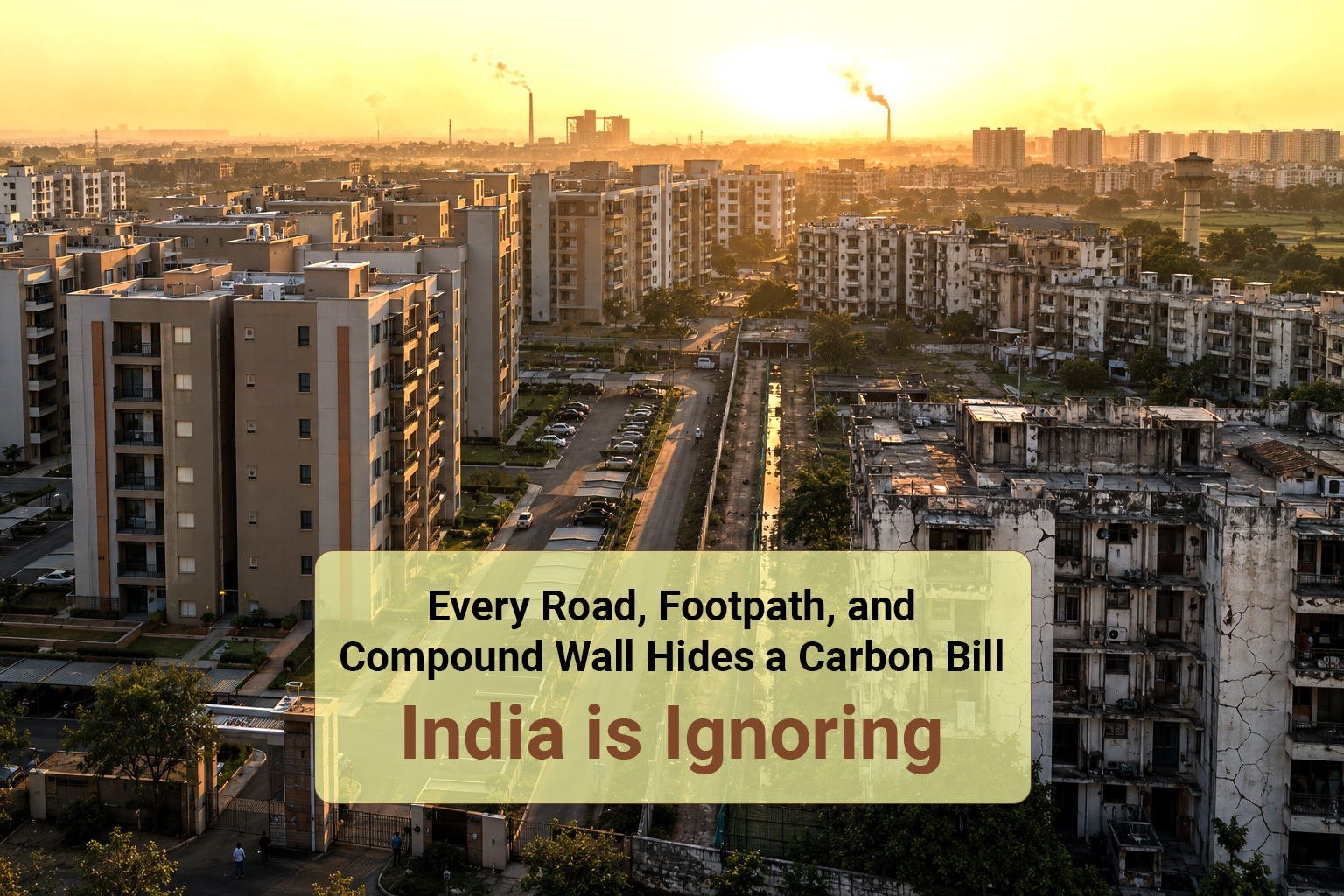
We scrutinise the buildings we live in. The infrastructure around them, the roads, the walls, the drains, escapes every question. That silence is costing the climate more than we can afford.

Authored by:
Abhishek Chhazed, Co-Founder & CTO
Eco Path Innovations
Rajan Mehta bought his flat in a new gated township on the outskirts of Bangalore in 2021. He walked every inch of the show apartment before signing. He checked the tile grade, the window glazing, and the kitchen slab finish. What he did not check was what no one at the sales office suggested he check, and what no brochure mentioned was the road outside his door. Or the compound wall running the perimeter of his new home. Or the storm drains channelling the next monsoon away from his building’s foundation.
Three years later, that internal road has already been patched twice. The compound wall is showing hairline cracks. The maintenance association is arguing over who pays for resurfacing.
The carbon bill for all of it, the road, the wall, the drains, was issued the moment those materials were made. It sits in the atmosphere now, will stay there for decades, and no one in the transaction paused to read it.
This is the story of infrastructure India is building at an extraordinary scale, measuring almost not at all, and paying for in ways that will compound long after the cheques have cleared.
THE SCOPE OF THE PROBLEM
The Road Sector’s Free Pass
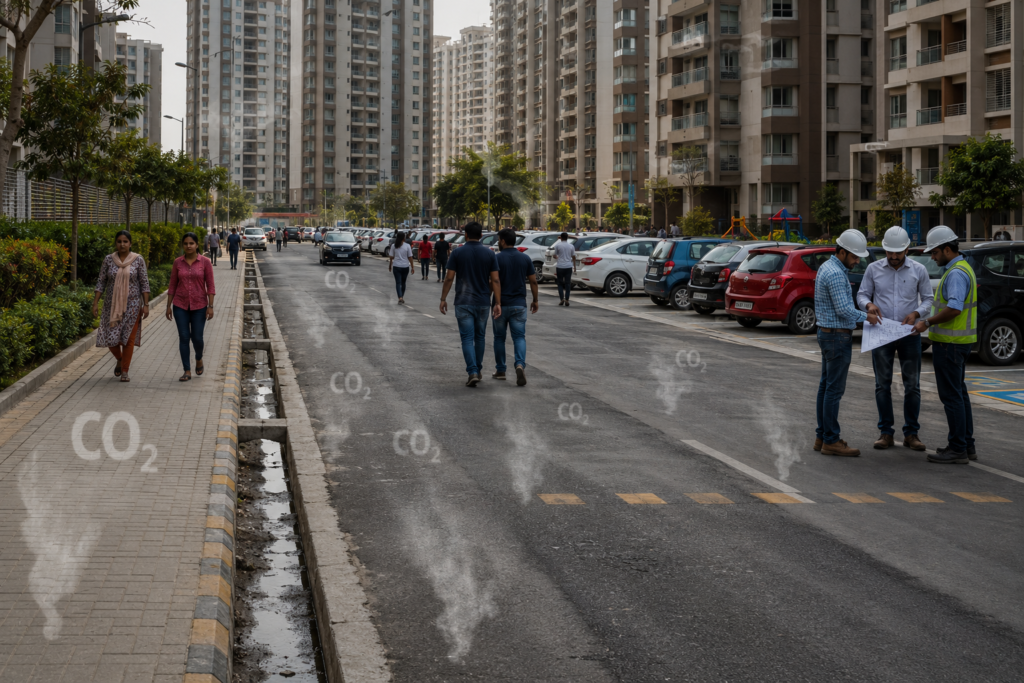
India’s building sector is, by global standards, increasingly self-aware about its environmental impact. Green building ratings have proliferated. Developers market energy efficiency. Sustainability reports are filed, certifications pursued, and press releases written. But the scrutiny stops at the building’s edge. Step outside onto the footpath, the internal road, the parking apron, and you have entered a zone of near-total accountability blindness.
The numbers are not abstract. The road sector alone accounts for roughly 40 per cent of India’s infrastructure-related pollution. Footpaths, compound walls, drainage channels, and parking lots collectively consume millions of tonnes of carbon-intensive concrete every year. Almost none of it appears in any sustainability framework, developer disclosure, or buyer checklist.
The road outside your house may last three years. The carbon emitted will last three hundred years.
This is not a niche concern about the fine print of climate accounting. India is in the middle of one of history’s largest infrastructure build-outs. Urban housing, highway expansion, and new township development, the construction pipeline runs into hundreds of billions of dollars. The material choices embedded in that pipeline will determine, in significant part, whether India can meet its climate commitments.
THE CEMENT PROBLEM
The Material Holding India Together Is Also Holding Back Its Climate Goals
To understand why external infrastructure carries such a heavy carbon burden, you have to understand cement. The material is the foundation of virtually everything that we are building in the concrete jungle.
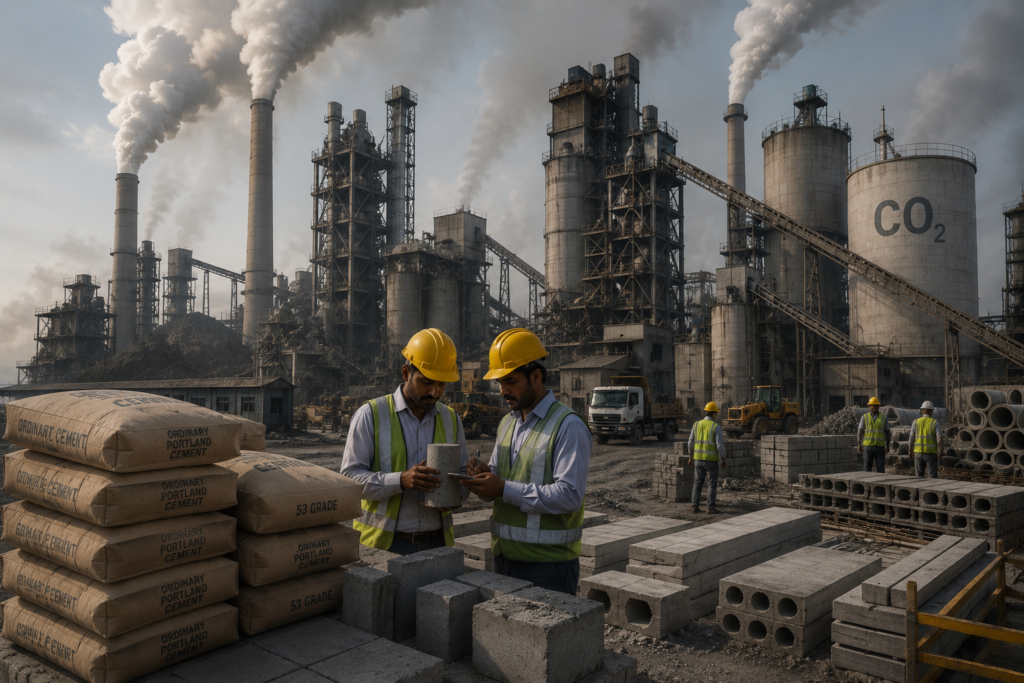
For every tonne of cement produced, between 0.8 and 1.0 tonnes of CO₂ are released into the atmosphere. This is not a byproduct of inefficiency or poor engineering. It is a chemical inevitability: the calcination of limestone, the central reaction in clinker production, produces CO₂ as a direct output regardless of how the kiln is powered or optimised. In 2024–25, India’s cement industry generated nearly 300 million tonnes of CO₂. For context, that is equivalent to the total annual emissions of several mid-sized European nations.
The scale of cement consumption in external infrastructure is rarely appreciated. A single kilometre of road embeds a carbon quantity equivalent to years of household emissions. A residential compound wall running the boundary of a standard housing society carries a carbon debt that is invisible to every person who walks past it daily. Drainage channels. Footpath kerbs. Parking lot slabs. All of it was built from cement. All of it emitting at the point of manufacture and then standing in the landscape, inert, for decades, the carbon long gone into the air, the structure slowly degrading toward its next resurfacing.
What would it mean to address this? The chemistry already exists. Industrial by-products — fly ash from thermal power stations, granulated blast furnace slag from steel manufacturing — can substitute for conventional Portland cement clinker at high replacement rates, cutting embodied carbon by 60 to 80 per cent without sacrificing structural performance. These are not experimental materials. They are proven, scalable, and increasingly available, given that India generates enormous quantities of both at its power plants and steel mills.
What has been lacking is the procurement discipline to insist on them — the same rigour applied in pharmaceutical manufacturing to ingredient sourcing and traceability, brought to bear on infrastructure material selection. In a sector where ‘what goes into the road’ has historically been an afterthought settled by whoever offered the lowest unit price, this would represent a fundamental change in how the industry thinks.
THE WATER STORY
The Invisible Resource Draining Away on Every Construction Site
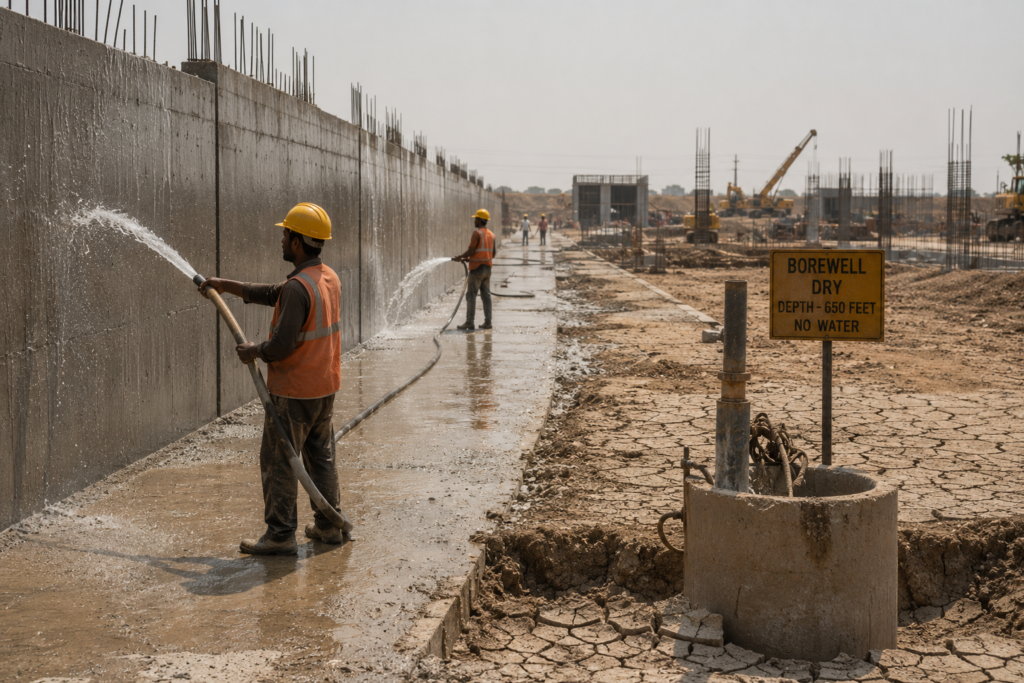
Carbon is not the only hidden cost of conventional concrete infrastructure. Water — a resource India is depleting at a pace that should command headlines daily — is consumed on construction sites at staggering rates, almost entirely out of public view.
For every square metre of wall construction alone, an average of 350 litres of water is consumed in the curing process. Freshly poured concrete must be kept continuously moist for days or weeks to achieve its design strength. This is not incidental. It is a core requirement of conventional cement chemistry, and at the scale of India’s infrastructure programme, it represents a colossal and largely untracked withdrawal from an already stressed water system.
India is facing water stress across more than twelve states. Groundwater tables are falling. Cities are rationing supply. Farmers are drilling deeper each season. And yet construction sites across the country, including in acutely water-stressed regions, are routinely drawing from local groundwater to cure concrete. This fact rarely appears in any project disclosure. It is not measured. It is not reported. It is not considered a problem worth naming.
350 litres per square metre of wall just for curing. In a country where farmers are rationing water and cities are managing supply crises, the construction industry is quietly draining aquifers to build.
The technical solution to this is not speculative. Geopolymer chemistry is the process by which fly ash and slag are activated through an alkaline reaction rather than the hydraulic hardening of conventional cement, and does not require water curing. The chemical process proceeds without it. Precast products made with geopolymer binders achieve full design strength with zero on-site water consumption for curing. Not reduced water consumption. Zero.
At the scale of India’s infrastructure build-out, this is not a marginal improvement. It is a structural shift in how a water-stressed nation builds its cities, one that is currently available, commercially viable, and almost entirely overlooked.
THE HOMEBUYER BLIND SPOT
The Road in Front of Your New Home Matters as Much as the Home Itself

Walk into any residential project sales office in India, and you will be shown marble samples, kitchen counter finishes, tile grades, window specifications, and bathroom fixture brands. The presentation is detailed, polished, and designed to signal quality at every turn.
Ask about the compound wall, ask what the internal road is made of, and ask about the design life of the drainage channel running past your building’s entrance. The silence that follows is not embarrassment. It is simply unfamiliarity. Nobody asks. Nobody has ever been expected to ask.
This is a significant oversight for reasons that are practical long before they are environmental. The quality and material profile of a project’s external development infrastructure directly determines how long it lasts, how much it costs to maintain, and increasingly what green building rating the project can claim. A developer who builds a thoughtful interior and then installs the cheapest conventional concrete in every external application is making a financial decision that will arrive as a maintenance bill in residents’ letterboxes within three to five years.
Conventional internal roads in residential projects can fail in as few as three years, cracking, potholing, and water ingress at joints. The carbon was emitted when the road was built. The road is now failing. The residents’ association is now funding the resurfacing, and the developer is long gone.
The Indian government has read this signal clearly in the context of national highway construction. The policy push to increase precast usage in highways from 25 per cent to 75–80 per cent reflects a recognition that precast technology delivers better outcomes across every relevant metric: faster construction, longer service life, more consistent quality, and with the right material inputs, a dramatically lower carbon footprint.
THE NEW ECONOMICS
Low-Carbon Infrastructure at Comparable Cost Is No Longer a Promise — It Is a Product
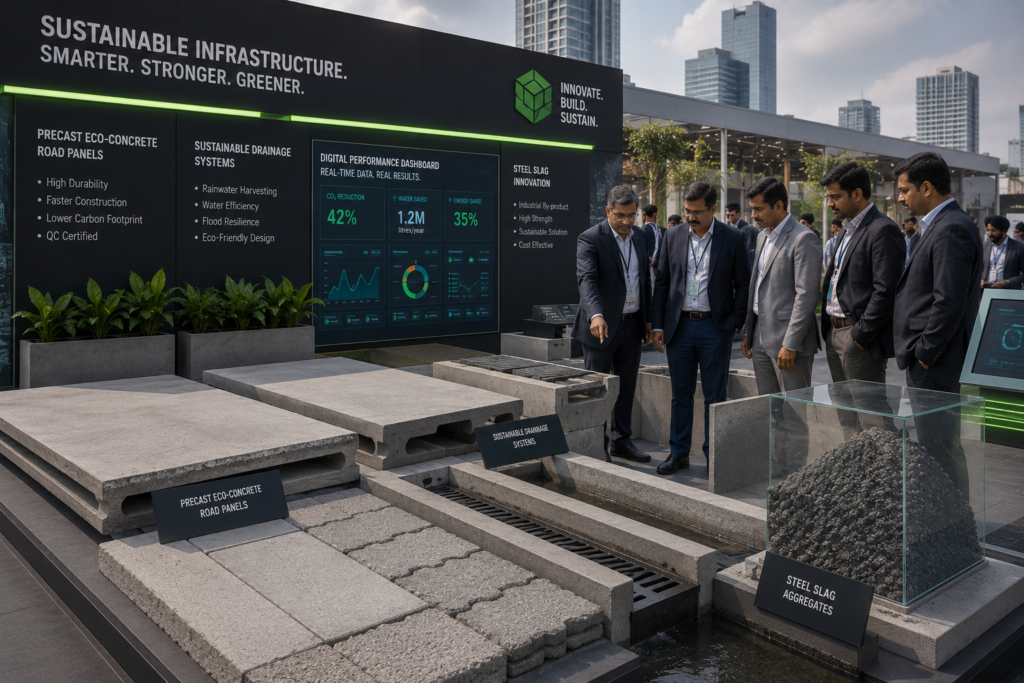
For a long time, ‘sustainable infrastructure’ in India carried an implicit premium, something reserved for ambitious projects with generous budgets and idealistic clients. That assumption is now obsolete. The economics of low-carbon external infrastructure have shifted decisively, driven by three forces converging at once: market scale, material innovation, and the growing availability of industrial waste streams as inputs.
The Indian precast concrete market is projected to reach USD 17.37 billion by 2033, growing at an 11.1 per cent CAGR. That scale matters. As manufacturing volumes grow, as supply chains mature, and as demand for engineered infrastructure products increases, the cost gap between conventional and low-carbon alternatives narrows and in some product categories, disappears entirely or reverses.
Consider steel slag roads. Roads built with steel slag aggregate are now demonstrating higher load-bearing capacity, longer service life, and lower total construction costs than conventional alternatives in comparable applications. The material was, until recently, classified as a disposal liability for steel manufacturers. It is now a performance advantage for infrastructure builders and a significant carbon improvement over virgin aggregate extraction.
The developers who adopt low-carbon external infrastructure now will not be making a sacrifice. They will be building a cost and marketing advantage that compounds as green rating requirements tighten and buyer awareness rises.
Ecopath’s approach to this problem begins with a simple insight: India’s industrial by-product streams are a resource, not a waste problem. Eco-Concrete, developed by Ecopath, is an innovative material that eliminates cement usage and uses industrial byproducts to deliver a quality and high durability material that has 80% lower carbon footprint and doesn’t need water for curing, unlike traditional concrete. Fly ash from thermal power plants, slag from steel manufacturing, exist in vast quantities and are chemically suited to replace conventional cement binders, and are currently underutilised relative to their potential.
Ecopath’s compound walls, road panels, footpath elements, and drainage systems are built from these inputs. The result is a product range that eliminates on-site curing water requirements, reduces embodied carbon by 80% compared to conventional alternatives, and critically performs at or above conventional specifications on every technical metric that matters to a buyer or specifier: compressive strength, service life, load rating, and dimensional consistency.
The business case for developers is not about making a sacrifice for the environment. It is about gaining an edge. First-mover advantage in low-carbon external infrastructure is real and compounding. The regulatory direction is unmistakable. The market is moving. The developers and builders who establish the capability and the supply relationships now will be ahead of requirements, not scrambling to meet them.
WHAT NEEDS TO CHANGE (Carbon Bill)
A Mandate for Buyers, Builders, and Policymakers
The transformation required here does not depend on new technology being invented. It does not require a policy revolution or a financing breakthrough. The materials exist. The manufacturing capacity is being built. The performance data is available. What is required is a shift in who asks which questions — and what standard those questions are held to.
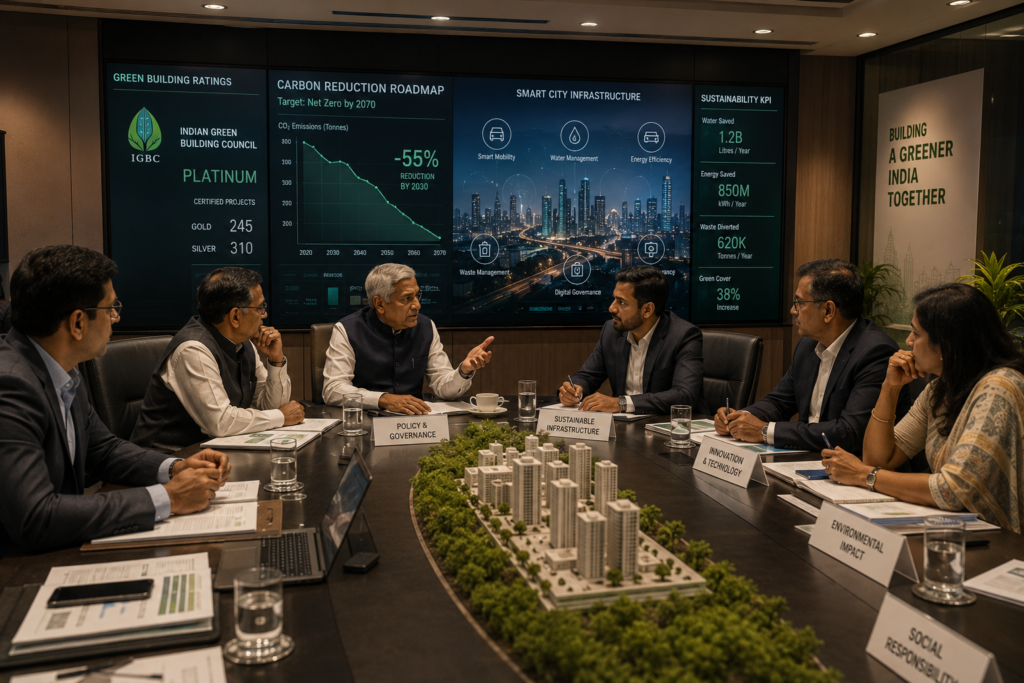
For homebuyers, the starting point is simple: ask. Ask your developer to specify the material and design life of compound walls, internal roads, and footpaths before you sign. Ask whether the project’s green rating covers external infrastructure or only the building. Ask about maintenance cycles. A developer who can answer clearly has thought about it. A developer who cannot. That distinction is information worth having before a purchase decision.
For developers, the horizon is three to five years. Green-rated external infrastructure will shift from a differentiator to an expectation within that window and in the premium residential and commercial segments, possibly sooner. The developers who build the evidence base now, who establish the supply relationships, the procurement frameworks, and the marketing language for low-carbon external infrastructure, will define the standard that everyone else is measured against. The cost of moving early is low. The cost of moving late is not.
For policymakers, the tools already exist; the question is whether there is the will to use them with greater force. India’s private residential sector is not operating in a standards vacuum. Green building rating systems like IGBC, GRIHA, and LEED India are established, recognised, and increasingly referenced in project marketing. The framework is there. What is missing is the ambition of its application and the rigour of its enforcement. A green building rating that excludes external infrastructure from its scope is grading half a project. A certification process that does not verify material inputs against claimed specifications is issuing trust on a handshake. Policymakers have the credibility and the institutional reach to change both. Raising the bar on what qualifies for a green rating — specifically by extending coverage to roads, compound walls, drains, and footpaths within residential projects — would sharpen the incentive without creating new bureaucracy. Linking those ratings to tangible benefits developers already want — faster approvals, additional FSI, reduced development charges, access to green financing — would ensure that higher standards are embraced rather than merely tolerated. The Gati Shakti programme’s push for infrastructure is exactly in the right direction.
Rajan Mehta is having the internal road in his housing society resurfaced this winter. It will be the second time in four years. The cost will come from the maintenance fund that every resident pays into monthly. The carbon was already spent the first time the road was built, and it will be spent again.
He did not know to ask about the road when he bought the flat. No system would have told him. No developer would have volunteered the information. No rating or regulation would have required either party to care.
The road outside your home may last three years. The carbon emitted will last three hundred years. The only question still open is who decides, and when, that this is a bill worth reading before it is issued.
External Links:
https://squarefootstory.com/dakhin-dilli-a-journey-of-sacred-art-from-north-to-south-india/