





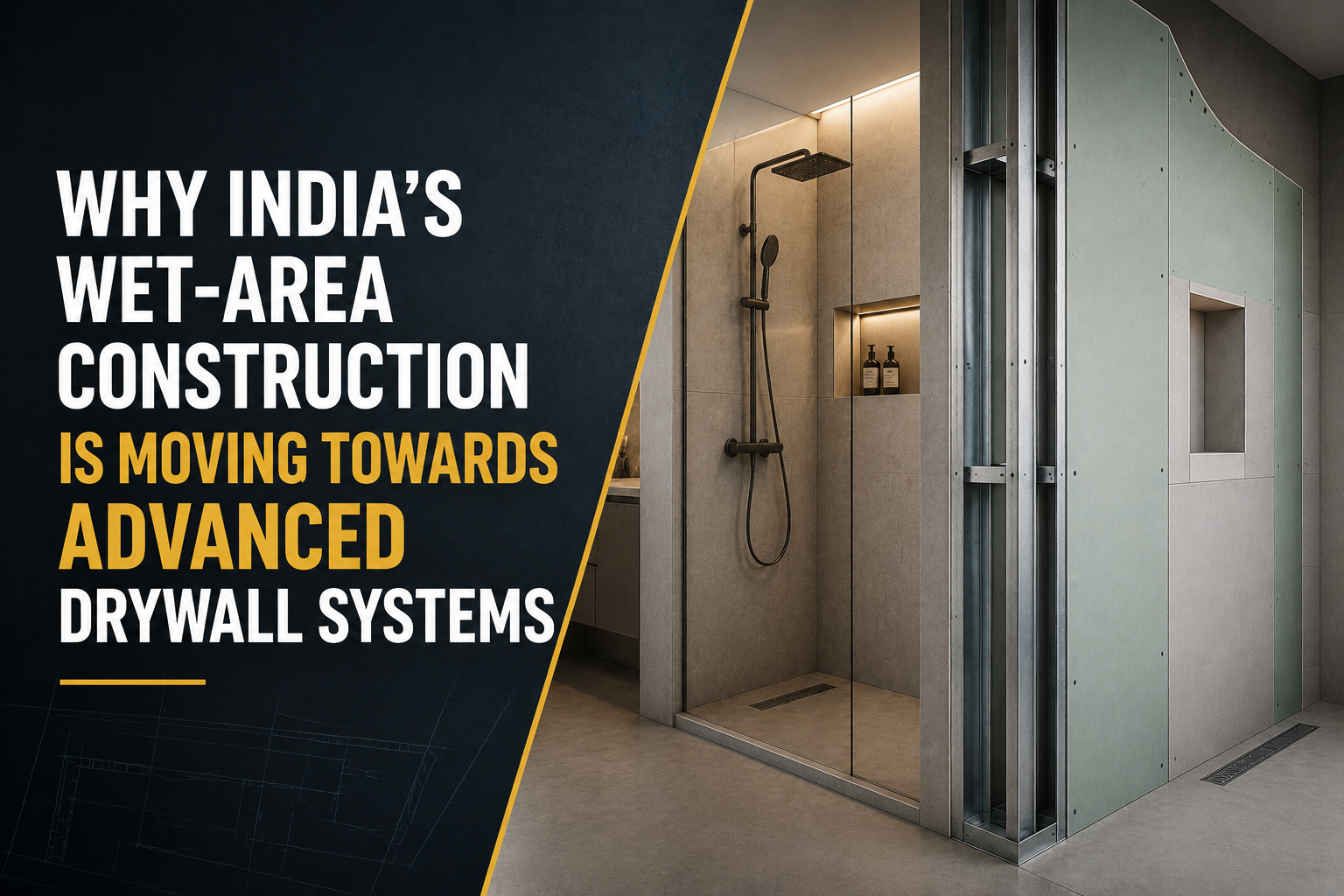
Advanced drywall systems are catching the eyes of builders and homebuyers today, as it helps in reducing the time of construction. Gone are the days when you feel that the wall of your bathroom loses its sheen, a softness in the paint, a faint chalkiness, the tile that gives a hollow tap where the adhesive has quietly let go. What is changing now is not how we waterproof those walls, but what we decide to build them out of in the first place.
The slow leak nobody budgets for
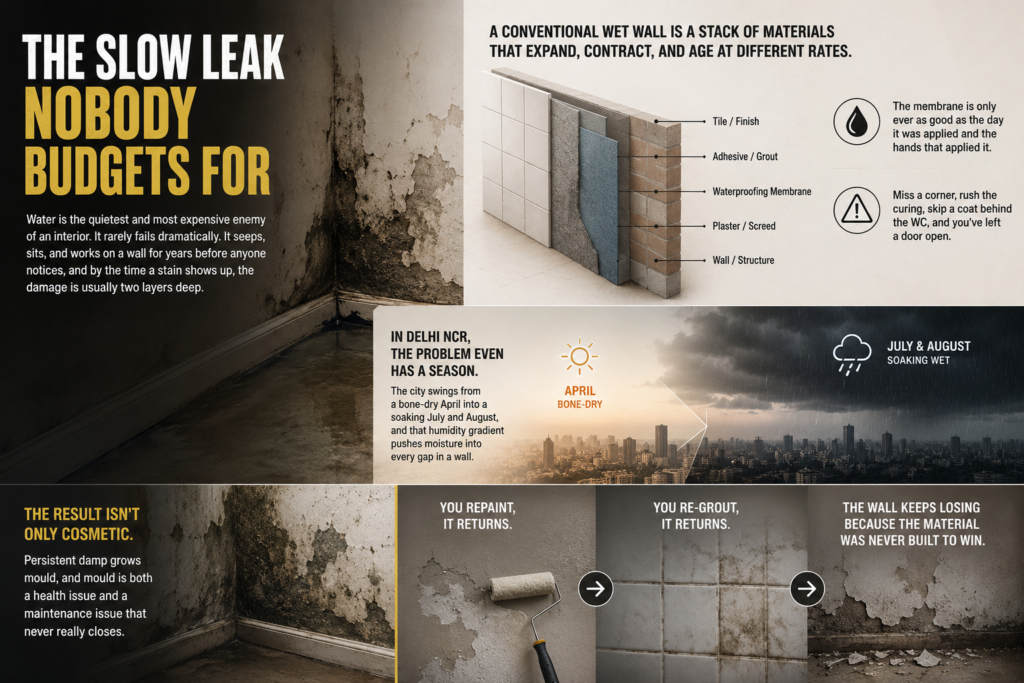
Water is the quietest and most expensive enemy of an interior. It rarely fails dramatically. It seeps, sits, and works on a wall for years before anyone notices, and by the time a stain shows up, the damage is usually two layers deep.
A conventional wet wall is a stack of materials that expand, contract, and age at different rates. The membrane is only ever as good as the day it was applied and the hands that applied it. Miss a corner, rush the curing, skip a coat behind the WC, and you’ve left a door open. In Delhi NCR, the problem even has a season. The city swings from a bone-dry April into a soaking July and August, and that humidity gradient pushes moisture into every gap in a wall.
The result isn’t only cosmetic. Persistent damp grows mould, and mould is both a health issue and a maintenance issue that never really closes. You repaint, it returns. You re-grout, it returns. The wall keeps losing because the material was never built to win.
Why are the walls changing now?
Several forces are pushing the industry towards dry construction at the same time, and none of them are about fashion.
The first is speed. RERA timelines and the delivery promises of branded residences have made handover dates real in a way they weren’t a decade ago. Wet trades, such as masonry, curing, waterproofing, and tiling, are slow and weather-dependent. Dry systems go up faster and don’t sit around waiting for plaster to cure.
The second is labour. Skilled masons and good waterproofing applicators, in particular, are harder to find and more expensive to keep. A board system that a smaller, less specialised crew can install correctly is no longer a luxury. For a lot of sites, it’s simply the only way to hit the schedule.
The third is sustainability. With IGBC and GRIHA ratings now part of how serious projects position themselves, materials that carry environmental product declarations and cut wet waste on site earn their keep. Lighter walls also mean lighter structures, which ripple all the way back down to the foundation.
Put together, these pressures make the old wet wall look less like a default and more like a habit.
Two generations of the same idea
It helps to see moisture-resistant boards as an evolution rather than a single shelf, because the four names most often discussed in the market right now actually fall into two very different generations.
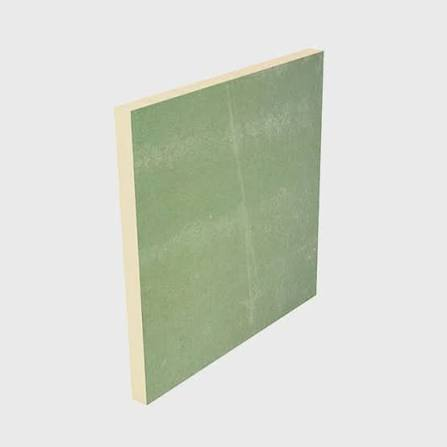
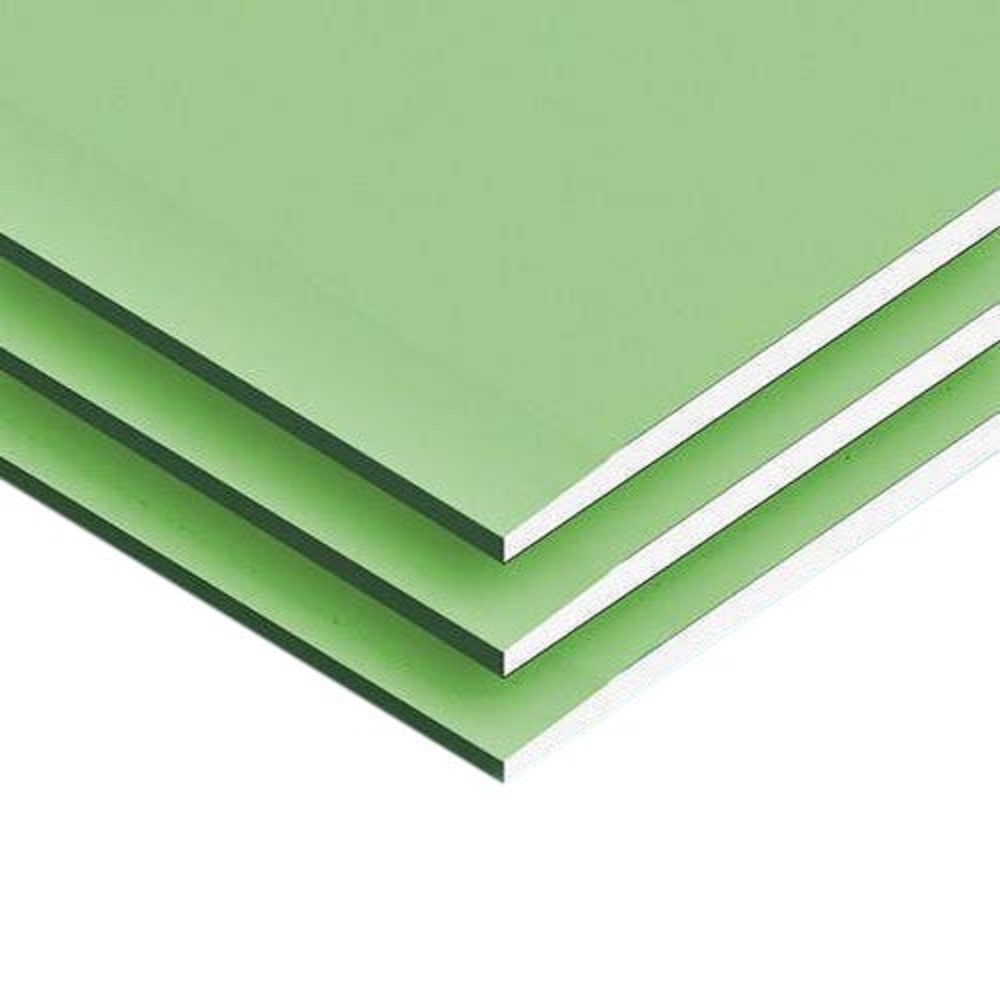
The first wave is the moisture-resistant board, which most contractors already know as the “green board.” Gyproc MR and USG Boral MoistBloc live here. Both use a treated core and a water-repellent green facing built to survive the periodic humidity of a ventilated bathroom or kitchen. They are a genuine step up from ordinary plasterboard. But they remain paper-faced, they still expect a full waterproofing system behind the tile, and they are not meant for surfaces that stay wet. They resist humidity; they don’t relish water.
The second wave changes the surface itself, and that is the entire point. Saint-Gobain’s Glasroc H swaps paper for hydrophobic glass-mat liners over a glass-fibre-reinforced gypsum core. It takes on less than five percent of its weight in water, holds its strength even while wet, and earns a perfect 10 on the ASTM D3273 mould test, the highest rating that test gives. More striking for Indian homes, it can carry up to 60 kilograms of stone per square metre, which means marble and granite can be clad directly onto a drywall, and in many assemblies, it thins out or replaces the separate waterproofing layer rather than leaning on it.
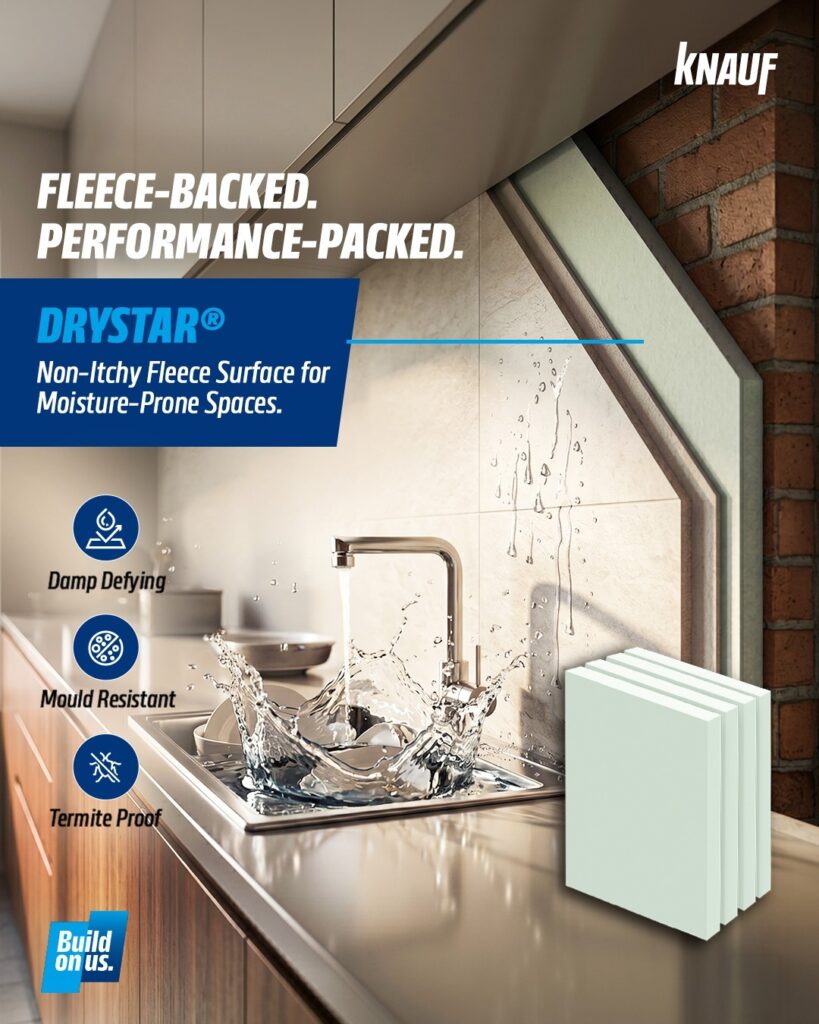
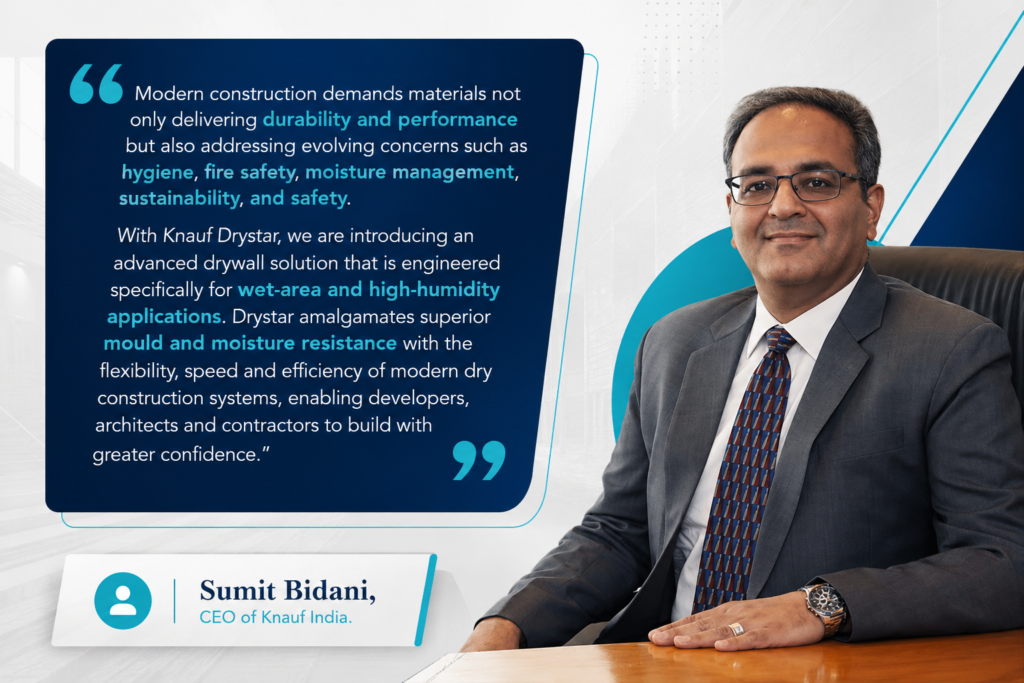
Knauf’s DRYSTAR, launched in India only this month, arrives at the same destination as the other major player. It pairs a moisture-resistant glass-fleece surface with an engineered gypsum core, keeps water absorption under three percent, shrugs off termites, bends to curved surfaces, and carries an A2-s1,d0 fire rating, which is to say it’s non-combustible, something that matters as much in a hospital corridor as in a hotel. Knauf has been explicit about the spread it’s built for washrooms, spas, diagnostic centres, even covered balconies and entrance canopies.
For more information, visit: https://knauf.com/en-IN
Where it actually matters
The reason this reads as “bathrooms to hospitals” and not as a renovation footnote is that the stakes climb sharply as you move across building types.
In hospitality, a damp patch in a hotel bathroom or a spa is a reputation problem long before it’s a repair bill. These are also the spaces that get renovated most often, and a board that lets a crew tile sooner and reopen rooms faster pays for itself in occupancy.
In healthcare, mould stops being cosmetic altogether. In patient washrooms, diagnostic suites, and laboratories, mould resistance is part of infection control, and a non-combustible, wipe-clean wall is a clinical requirement rather than a nice-to-have. This is the application that most clearly earns the new generation’s premium.
In residential, the pull is aspirational. Branded and luxury residences across Gurugram and Noida sell on finish, and the ability to hang heavy marble on a fast, dry, moisture-stable wall lets developers deliver that look without the dead weight and the wait of conventional masonry.
In commercial spaces, office pantries, washrooms, and retail back-of-house, the appeal is unglamorous and entirely practical. Build it quickly, service it easily, and don’t think about it again for a long time.
| Feature | Knauf DRYSTAR | Gyproc Glasroc H | Gyproc MR | USG MoistBloc |
|---|---|---|---|---|
| Moisture Resistance | Very High | Very High | Medium-High | High |
| Mold Resistance | High | Excellent | Good | Good |
| Tile Load Capacity | High | Up to 60 kg/sqm | Moderate | Moderate |
| Termite Resistance | Yes | Yes | Limited | Limited |
| Wet Area Suitability | Excellent | Excellent | Good | Good |
| Hospitality Projects | Yes | Yes | Limited | Yes |
| Healthcare Projects | Yes | Yes | Moderate | Moderate |
| Luxury Residential | Yes | Yes | Yes | Yes |
The question architects are still arguing about

None of this means brick is finished, and the honest version of this story is that the industry is genuinely split. So it’s worth putting the real question on the table, the one we’d ask any architect working on NCR projects today?
Do you see advanced moisture-resistant drywall systems replacing conventional masonry in wet areas over the next five years?
The case for masonry is mass, familiarity, and trust. A brick wall feels permanent, takes abuse, and every contractor in the country knows how to build one. The case against it is everything above speed, labour, weight, waste, and a lifecycle cost that quietly favours a wall designed not to absorb water in the first place. Where the new boards still have to prove themselves is in the long Indian middle, the projects without specialist crews, where a system is only ever as strong as its weakest installer, and where a board that demands correct detailing can fail just the way a rushed membrane does.
That, far more than any spec sheet, is what the next five years will actually test.
Performance, not tradition
The interesting argument in wet-area construction is no longer gypsum versus brick. It has moved to performance versus maintenance, to which wall costs less to own across fifteen years, not which one is cheaper to throw up in a week. Boards like Glasroc H and DRYSTAR suggest the next generation of interiors will be shaped by moisture resistance, faster execution, and lifecycle durability rather than by how things have always been done.
For anyone buying a home, there’s a quieter takeaway underneath all of it. What sits behind the bathroom tile is one of the few parts you’ll never see and never inspect, which is exactly why it tells you so much. A builder’s choices in the places that don’t show up in the brochure are usually the truest measure of how seriously they treat the ones that do.
From SFS Desk:
https://squarefootstory.com/stamp-duty-a-guide-for-every-property-buyer/
https://squarefootstory.com/from-clv-to-cev-why-real-estates-future-lies-in-engagement-not-just-transactions/